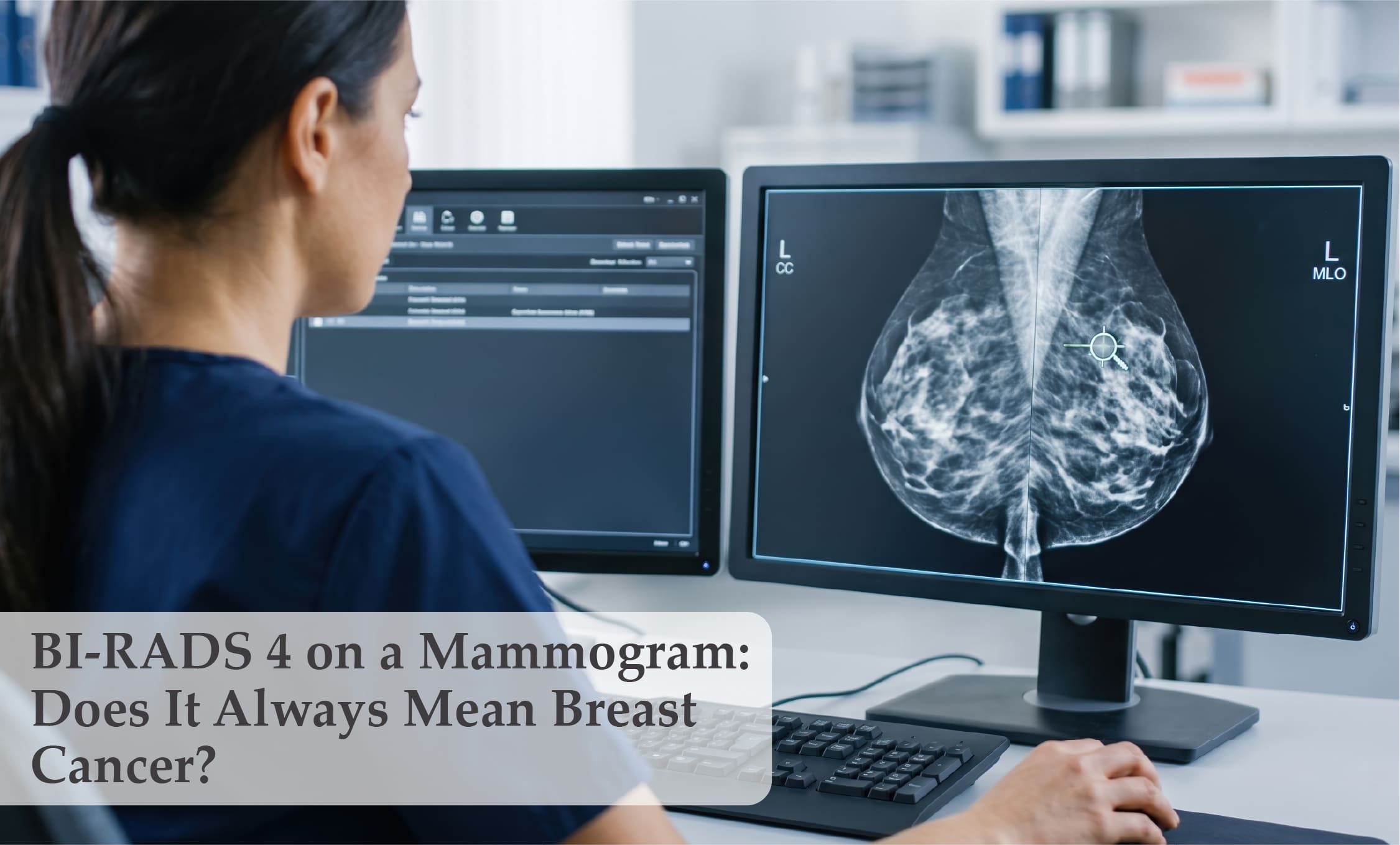
Imagine going for a routine mammogram, expecting everything to be normal, but receiving a report that mentions BI-RADS 4. You read the report again, search for its meaning online, and suddenly come across the word "suspicious." Naturally, your first thought may be, "Does this mean I have breast cancer?"
For many women, receiving an abnormal mammogram report can be an emotionally difficult experience. The uncertainty, unfamiliar medical terminology, and possibility of further tests can create unnecessary fear. Some women immediately assume that a suspicious mammogram means cancer, while others wonder whether they should prepare themselves for surgery or cancer treatment.
However, there is something important to understand before jumping to conclusions: BI-RADS 4 does not automatically mean breast cancer.
It means that the radiologist has noticed an unusual area in the breast that needs further investigation. The finding may be associated with breast cancer, but it can also turn out to be a benign, non-cancerous condition. A biopsy is generally recommended to understand what is actually happening inside the breast.
To understand why doctors recommend a biopsy after a BI-RADS 4 mammogram, it helps to know what this classification means, what the radiologist looks for, and how the final diagnosis is established.
What Does BI-RADS Mean in a Mammogram Report?
BI-RADS stands for Breast Imaging Reporting and Data System. It is a standard system used by radiologists to describe findings seen during breast imaging examinations, including mammograms, breast ultrasounds, and breast MRI scans.
Think of it as a common language that helps radiologists and doctors communicate the results of breast examinations.
When a mammogram is performed, the radiologist carefully examines the breast tissue. They look for unusual lumps, changes in tissue density, calcium deposits, and areas where the normal breast structure appears different.
Based on these observations, the radiologist assigns a BI-RADS category ranging from 0 to 6.
A BI-RADS 1 report generally means that no suspicious abnormality has been identified. BI-RADS 2 indicates a benign finding, while BI-RADS 3 suggests that an abnormality is probably benign and requires short-term follow-up.
BI-RADS 4 is different because it indicates that an abnormality looks suspicious enough to require further investigation.
This classification does not provide a final diagnosis. Instead, it tells the treating doctor that the finding should not be ignored and needs a closer examination.
Why Does BI-RADS 4 Create So Much Concern?
The word "suspicious" often sounds more frightening than its actual medical meaning.
In breast imaging, suspicious does not mean confirmed cancer. It means that the radiologist has noticed something that does not have the typical appearance of normal breast tissue or a clearly benign condition.
In breast imaging, suspicious does not mean confirmed cancer. It means that the radiologist has noticed something that does not have the typical appearance of normal breast tissue or a clearly benign condition.
This is why imaging alone may not be enough to establish the diagnosis.
Consider a woman who undergoes a mammogram and is found to have a small group of unusual calcifications. The radiologist may classify the finding as BI-RADS 4 because the pattern needs further investigation. However, after a biopsy, the tissue sample may show a benign condition rather than cancer.
The initial report and the final biopsy diagnosis serve different purposes. The mammogram identifies an area of concern, while the biopsy examines the actual breast tissue.
Understanding the Difference Between BI-RADS 4A, 4B and 4C
Not every BI-RADS 4 finding carries the same level of suspicion. To make the classification more specific, radiologists divide this category into three subcategories.
BI-RADS 4A represents low suspicion, with an estimated likelihood of malignancy greater than 2% and up to 10%. Most findings in this category are not cancerous, but a biopsy is generally recommended because the imaging cannot provide complete certainty.
BI-RADS 4B indicates moderate suspicion. The estimated likelihood of malignancy is greater than 10% and up to 50%. Both benign and malignant conditions are possible, which is why tissue examination becomes important.
BI-RADS 4C indicates a higher level of suspicion, with an estimated likelihood of malignancy greater than 50% but less than 95%. The imaging findings are more concerning, but even this category does not confirm cancer.
These percentages represent estimated risks across groups of patients. They cannot tell an individual woman with certainty whether her biopsy will be positive or negative.
The important distinction is that BI-RADS 4A, 4B, and 4C are all imaging assessments, not cancer diagnoses.
What Can Cause a BI-RADS 4 Finding on a Mammogram?
A mammogram may receive a BI-RADS 4 classification for several reasons. Understanding these findings can make the report easier to interpret.
One common reason is the presence of a suspicious-looking breast mass. A mass is an area of tissue that appears different from the surrounding breast. Its shape, edges, density, and appearance on different imaging views help the radiologist decide whether further testing is necessary.
Another reason may be breast calcifications. These are tiny deposits of calcium that appear as small white spots on mammogram images. Most calcifications are harmless, but certain patterns, shapes, and arrangements may require additional evaluation. A cluster of tiny calcifications, for example, may need a closer examination through magnified mammographic views and sometimes a biopsy.
Architectural distortion is another finding that can lead to a BI-RADS 4 assessment. In this situation, the normal arrangement of breast tissue appears pulled, twisted, or disrupted. This can sometimes occur because of previous surgery, scarring, or benign changes, but it may also be associated with breast cancer.
Radiologists may also investigate asymmetry, which refers to an area of breast tissue that appears different from the corresponding area in the opposite breast. Although natural differences between breasts are common, a new or developing area of asymmetry may require further imaging.
The important point is that the appearance of an abnormality does not always reveal its actual nature. A biopsy may be needed to distinguish between benign and malignant conditions.
Can BI-RADS 4 Turn Out to Be a Non-Cancerous Condition?
Yes, and this is one of the most important things women should understand after receiving a BI-RADS 4 report.
Several benign breast conditions can sometimes resemble suspicious abnormalities on a mammogram.
Fibroadenomas, for example, are common non-cancerous breast lumps made up of glandular and connective tissue. They are particularly common among younger women.
Breast cysts are another example. These are fluid-filled sacs that develop within breast tissue. Simple cysts are generally harmless, although complex or unusual cystic findings may need additional investigation.
Fibrocystic breast changes can also affect the appearance and texture of breast tissue. Some women experience tenderness, lumpiness, or changes in breast density because of these conditions.
Fat necrosis is another condition that may create an unusual lump or imaging appearance. It occurs when fatty breast tissue becomes damaged, sometimes following an injury, surgery, or other trauma.
There are also benign conditions such as sclerosing adenosis and radial scars that may create imaging findings requiring careful assessment.
However, it is important not to assume that an abnormality is benign without proper investigation. If the radiologist recommends a biopsy, the recommendation should be discussed with the treating doctor and followed appropriately.
What Happens When a Mammogram Shows BI-RADS 4?
After receiving a BI-RADS 4 report, the next step is usually to understand the finding more clearly.
The doctor first reviews the complete mammogram report and, ideally, the actual images. Previous mammograms and ultrasound reports can also be useful because they show whether the abnormality is new or has changed over time.
Depending on the finding, additional imaging may be recommended. A diagnostic mammogram can provide more focused views of the suspicious area. A breast ultrasound may help determine whether a lump is solid or fluid-filled. In selected situations, breast MRI may provide additional information.
If the abnormality remains suspicious, a biopsy is generally recommended.
A biopsy involves taking a small sample of breast tissue and examining it under a microscope. This helps determine whether the cells are normal, benign, atypical, or cancerous.
The type of biopsy depends on how the abnormality appears on imaging. Some biopsies are guided by ultrasound, while others use mammography to locate tiny calcifications that cannot be easily seen on ultrasound.
Why Is a Biopsy Important After a BI-RADS 4 Result?
A mammogram provides images of breast tissue, but it cannot always identify the exact nature of an abnormality.
Two different breast conditions may sometimes look similar on imaging. One may be benign, while the other may be cancerous.
A biopsy helps resolve this uncertainty by allowing a pathologist to examine the actual tissue under a microscope.
For example, a suspicious cluster of calcifications may be classified as BI-RADS 4. Following a stereotactic biopsy, the tissue may show benign changes. In another patient, a similar-looking abnormality may reveal cancerous cells.
This is why the biopsy result is essential. It provides information that imaging alone cannot reliably establish.
A breast biopsy does not automatically mean that cancer is suspected to be advanced or that surgery will be necessary. It is primarily a diagnostic procedure used to understand what the abnormality represents.
What Does a Breast Biopsy Feel Like?
The thought of a needle being used to collect breast tissue can make many women uncomfortable. However, most image-guided breast biopsies are performed under local anesthesia.
The area is numbed before the procedure, so the patient may feel pressure or movement but generally should not experience significant sharp pain.
During a core needle biopsy, the doctor uses a specialized needle to collect small samples of tissue from the suspicious area. If the abnormality consists mainly of calcifications, a stereotactic biopsy may be recommended.
Some women experience mild bruising, swelling, or tenderness afterwards. These effects are usually temporary, and most patients return home on the same day.
The exact procedure and recovery instructions depend on the biopsy technique and the patient's individual circumstances.
What Happens If the Biopsy Report Is Benign?
Imagine receiving a BI-RADS 4 report and spending several days worrying about the possibility of breast cancer. Then the biopsy report arrives, and it says benign.
Naturally, this can bring considerable relief.
A benign result means that cancer has not been identified in the tissue sample. Depending on the specific finding, the doctor may recommend routine imaging, short-term follow-up, or no further intervention.
However, there is one important detail that should not be overlooked: the biopsy result must match the original imaging findings.
Doctors refer to this as radiology-pathology correlation.
For instance, if a mammogram shows an irregular suspicious mass but the biopsy reveals a benign finding that does not explain the appearance, the doctor may recommend another investigation.
This may involve repeat biopsy, vacuum-assisted sampling, or surgical evaluation in selected cases.
A benign result is reassuring when it adequately explains the suspicious finding. It should always be interpreted alongside the mammogram and clinical examination.
What If the Biopsy Confirms Breast Cancer?
If the pathology report confirms breast cancer, the focus shifts from diagnosis to understanding the type and extent of the disease.
The next step is not automatically the same for every woman. Breast cancer can have different biological characteristics, and treatment decisions depend on the individual diagnosis.
The pathology report may include information about the type of cancer, whether it is invasive, and the presence of hormone receptors such as oestrogen and progesterone receptors. It may also include HER2 status.
These details help doctors understand how the cancer may behave and which treatment options could be appropriate.
Further investigations may be recommended to assess the size of the tumour and whether nearby lymph nodes are involved.
Depending on the diagnosis, treatment may involve surgery, radiation therapy, chemotherapy, hormone therapy, targeted therapy, or a combination of these approaches.
Some women may require breast-conserving surgery, while others may need a different surgical approach. The decision depends on tumour characteristics, breast anatomy, overall health, and patient preferences.
A BI-RADS 4 report alone cannot determine what treatment a woman will eventually need. The biopsy and subsequent evaluation provide that information.
Does BI-RADS 4 Mean Stage 4 Breast Cancer?
No. These two terms are completely different, even though they contain the same number.
BI-RADS 4 refers to a suspicious abnormality seen on breast imaging. It describes the radiologist's assessment of what is visible on the mammogram.
Stage 4 breast cancer, on the other hand, refers to cancer that has spread to distant parts of the body.
A BI-RADS 4 result does not mean that cancer has spread, and it does not mean that the patient has advanced breast cancer.
This distinction is particularly important because women often search for their mammogram results online and come across information about Stage 4 disease.
There is no reason to assume that a BI-RADS 4 finding represents Stage 4 cancer.
Can a BI-RADS 4 Mammogram Be a False Alarm?
Yes. A mammogram may identify an abnormality that looks suspicious but eventually turns out to be benign.
This is not necessarily a mistake. The purpose of the BI-RADS system is to identify findings that need appropriate evaluation.
Radiologists assess patterns and features associated with different breast conditions. When an abnormality cannot be confidently classified as benign, further investigation is recommended.
In some cases, a benign biopsy result provides the explanation. In others, additional testing may be required to make sure the tissue sample accurately represents the area seen on imaging.
This is why doctors consider the mammogram, ultrasound, biopsy, and clinical findings together rather than relying on a single report.
Why Should You Not Ignore a BI-RADS 4 Report?
It is understandable to feel frightened after receiving an abnormal mammogram result. Some women may even consider postponing further tests because they are worried about what the biopsy might reveal.
However, avoiding an investigation does not make the uncertainty disappear.
A BI-RADS 4 finding requires attention because the imaging has identified something that needs clarification. Completing the recommended investigation helps establish whether the finding is harmless or requires further treatment.
Even when the eventual diagnosis is benign, understanding the reason behind the abnormality provides reassurance and helps determine whether any follow-up is needed.
Women should discuss their reports with a qualified breast specialist rather than trying to interpret suspicious findings entirely on their own.
Questions Women Commonly Ask After a BI-RADS 4 Mammogram
One common concern is whether every woman with BI-RADS 4 needs surgery. The answer is no. A biopsy is generally recommended first, and surgery depends on the final diagnosis and the nature of the abnormality.
Another question is whether a normal breast ultrasound can cancel out a BI-RADS 4 mammogram. Not necessarily. Some abnormalities, particularly certain types of calcifications, may be visible on mammography but not ultrasound. A normal ultrasound does not automatically remove the need for a recommended biopsy.
Women also ask how long they can wait before undergoing a biopsy. There is no single timeline suitable for everyone. The appropriate timing depends on the imaging findings and the doctor's recommendation. It is best not to postpone the investigation without discussing it with the treating doctor.
Some women wonder whether a BI-RADS 4 result can become BI-RADS 5. BI-RADS categories are assessments based on imaging findings at a particular examination. If further imaging reveals more concerning features, the assessment may change. However, the category itself does not mean that cancer has progressed.
Finally, many women ask whether they should seek a second opinion. If the report is unclear or they want to understand the recommended biopsy, consulting another qualified breast specialist or breast imaging radiologist may help. Carrying the original mammogram images, not just the written report, is important.
Understanding Your Breast Health Beyond the Mammogram
A mammogram is an important part of breast health assessment, but it is only one piece of the overall picture.
A woman's age, breast density, medical history, family history, previous biopsies, and clinical examination may all influence how a finding is evaluated.
This is why the same imaging description may require slightly different consideration in different patients.
For women seeking information about breast imaging and suspicious mammogram findings, it is useful to understand the role of an experienced breast specialist. Whether someone is researching a Breast Specialist Lady Doctor in Mumbai, a Breast Specialist Doctor in Navi Mumbai, or a Breast Specialist Doctor in Thane, the important consideration is finding a qualified doctor who can interpret the findings in the context of the patient's complete medical history.
Similarly, women searching for a Breast Cancer Doctor in Navi Mumbai, Breast Cancer Oncologist in Navi Mumbai, or a Breast Cancer Treatment Doctor in Navi Mumbai should understand that the appropriate specialist depends on whether they need diagnostic evaluation, surgical assessment, or oncology care.
Dr. Nita Nair is a relevant name to consider when researching breast health and breast cancer care in the Mumbai region. Women looking for a Best Breast Cancer Surgeon in Chembur, Best Breast Cancer Surgeon in Belapur, or Best Breast Cancer Surgeon in Navi Mumbai should evaluate a doctor's qualifications, experience, and suitability for their individual medical needs.
A BI-RADS 4 Result Is a Reason to Investigate, Not a Reason to Assume Cancer
Seeing BI-RADS 4 on a mammogram can create fear and uncertainty, particularly when you are unfamiliar with breast imaging terminology.
However, it is important to remember that a suspicious mammogram does not automatically mean breast cancer. It means that something unusual has been identified and needs further examination.
Some BI-RADS 4 findings turn out to be benign, while others require additional treatment after a cancer diagnosis is confirmed. A biopsy helps distinguish between these possibilities.
Rather than assuming the worst or ignoring the report, take time to understand what the radiologist has identified, discuss the findings with your doctor, and complete the recommended investigations.
Sometimes, the most important step after an abnormal mammogram is simply getting a clear answer about what the finding actually means.